See Plainhand in action
Three public-domain texts, run through the same free checks as the editor. Every highlight and note below comes straight from Plainhand.
Examples from Plainhand
Writing styles change over time, and Plainhand reflects current editing conventions. The flags on Frankenstein and Jane Eyre mark patterns a modern editor would point out in older prose, such as runs of sentences that open the same way or description stacked clause on clause. They aren’t a judgment that the writing is bad. Both books are classics, written for readers who expected those rhythms.
Anywhere you use it, a flag is a prompt to look again, not a verdict. What Plainhand shows is where a pattern repeats, so you can decide whether it’s doing work. All three texts were published in the United States before 1929 and are in the public domain there.
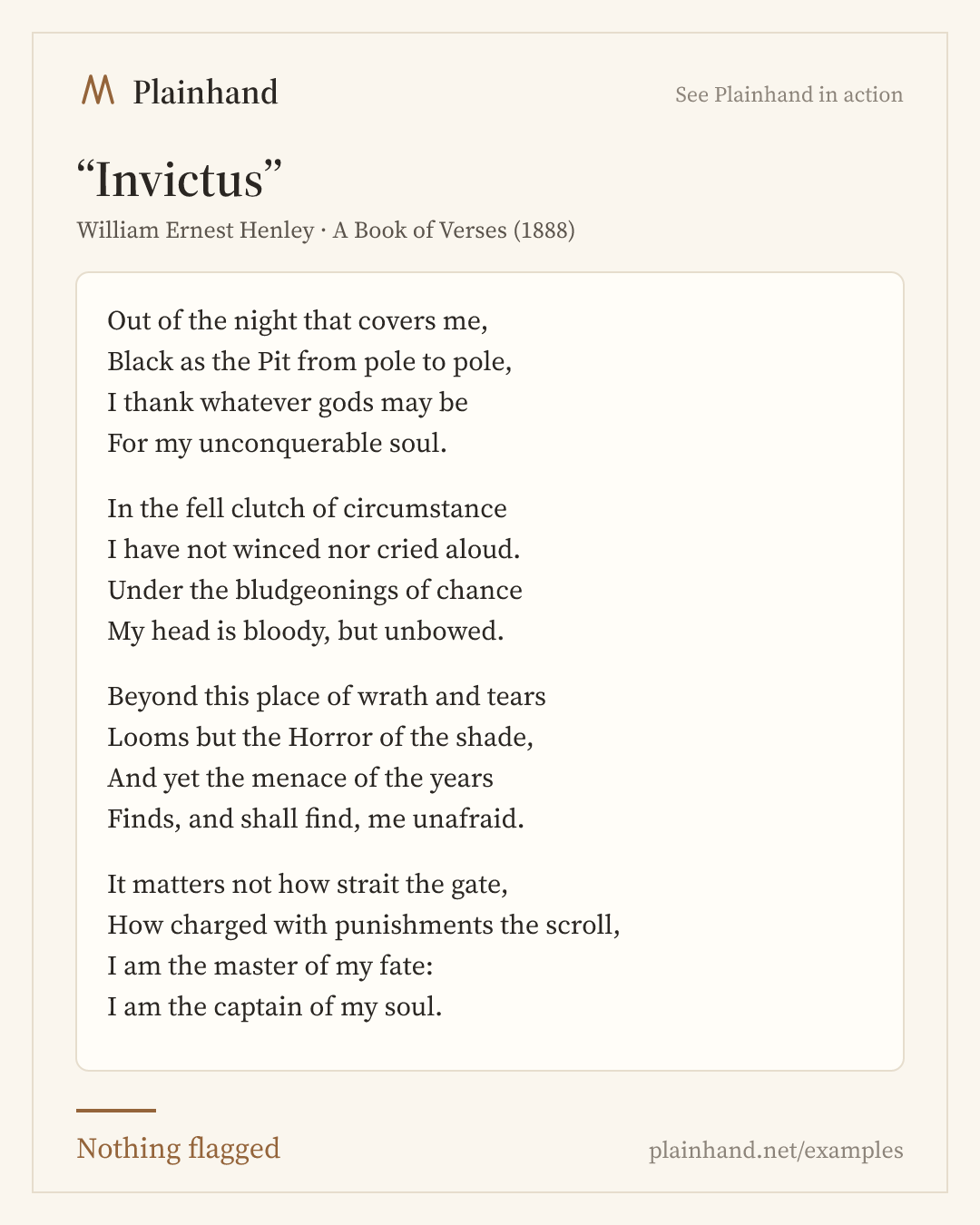
“Invictus”
William Ernest Henley, Invictus · First published, untitled, in A Book of Verses (1888). Text from Henley’s Poems (1898), Project Gutenberg eBook #1568.
Out of the night that covers me,
Black as the Pit from pole to pole,
I thank whatever gods may be
For my unconquerable soul.
In the fell clutch of circumstance
I have not winced nor cried aloud.
Under the bludgeonings of chance
My head is bloody, but unbowed.
Beyond this place of wrath and tears
Looms but the Horror of the shade,
And yet the menace of the years
Finds, and shall find, me unafraid.
It matters not how strait the gate,
How charged with punishments the scroll,
I am the master of my fate:
I am the captain of my soul.
Plainhand flagged nothing in this passage.
A tightly made poem: short lines, strong verbs, no filler, and no stock phrases. Plainhand finds nothing to flag. It’s built for prose, so poetry isn’t really its job, but a clean result is still a good sign.
Image of this example for sharing
Frankenstein
Mary Shelley, Frankenstein · First published 1818 · From Chapter 5. Text from Project Gutenberg eBook #84.
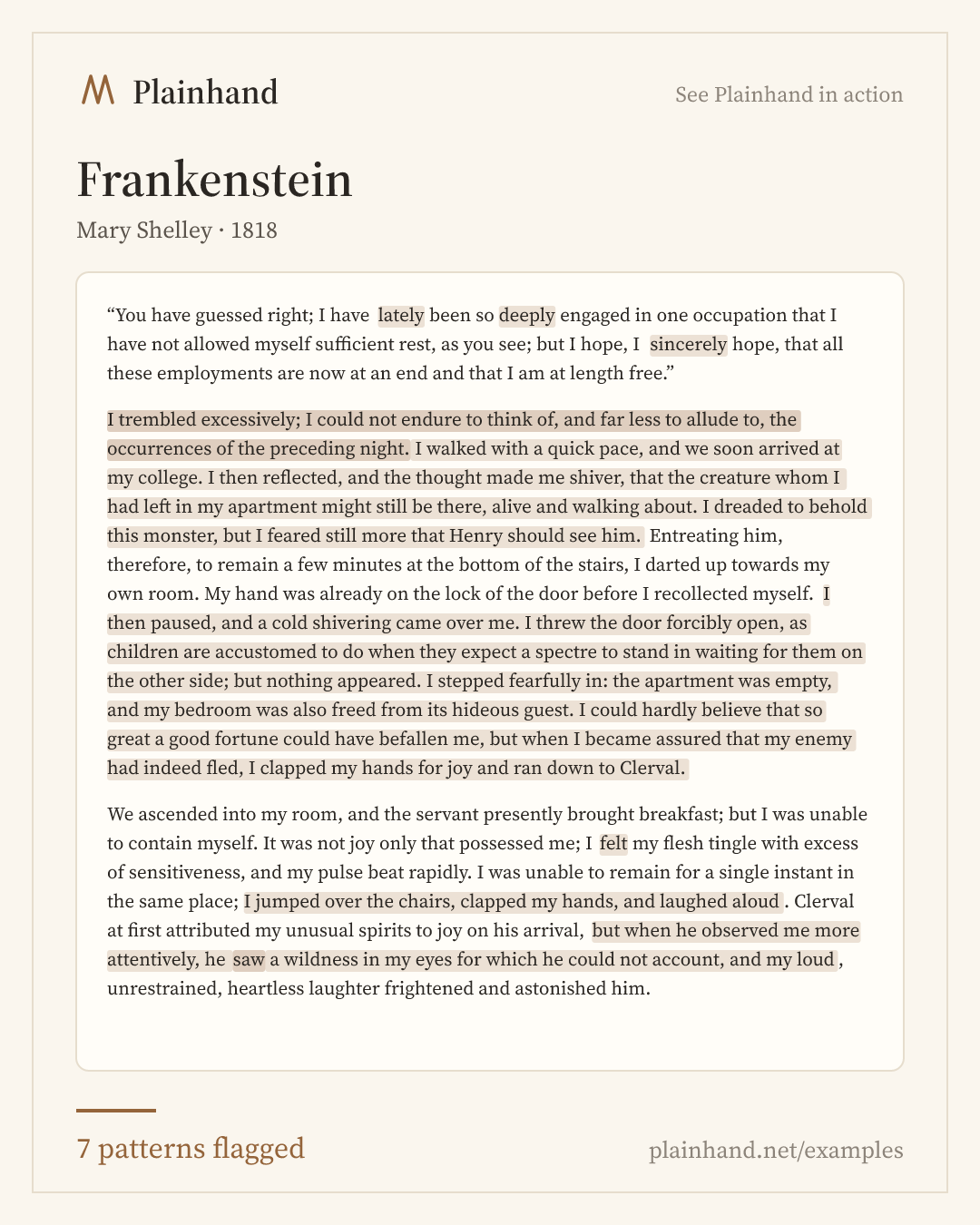
“You have guessed right; I have 1lately been so deeply engaged in one occupation that I have not allowed myself sufficient rest, as you see; but I hope, I sincerely hope, that all these employments are now at an end and that I am at length free.”
2,3I trembled excessively; I could not endure to think of, and far less to allude to, the occurrences of the preceding night. I walked with a quick pace, and we soon arrived at my college. I then reflected, and the thought made me shiver, that the creature whom I had left in my apartment might still be there, alive and walking about. I dreaded to behold this monster, but I feared still more that Henry should see him. Entreating him, therefore, to remain a few minutes at the bottom of the stairs, I darted up towards my own room. My hand was already on the lock of the door before I recollected myself. 4I then paused, and a cold shivering came over me. I threw the door forcibly open, as children are accustomed to do when they expect a spectre to stand in waiting for them on the other side; but nothing appeared. I stepped fearfully in: the apartment was empty, and my bedroom was also freed from its hideous guest. I could hardly believe that so great a good fortune could have befallen me, but when I became assured that my enemy had indeed fled, I clapped my hands for joy and ran down to Clerval.
We ascended into my room, and the servant presently brought breakfast; but I was unable to contain myself. It was not joy only that possessed me; I 5felt my flesh tingle with excess of sensitiveness, and my pulse beat rapidly. I was unable to remain for a single instant in the same place; 6I jumped over the chairs, clapped my hands, and laughed aloud. Clerval at first attributed my unusual spirits to joy on his arrival, but when he observed me more attentively, he 7saw a wildness in my eyes for which he could not account, and my loud, unrestrained, heartless laughter frightened and astonished him.
Plainhand flagged 7 patterns in this passage.
Victor’s narration runs on nerves: two runs of four sentences that each start with “I”, a cluster of adverbs, and feelings reported rather than shown. Some of that is the point, since he’s barely holding together, but the flags show where the rhythm repeats.
- Too many adverbs. “lately” Adverb-heavy in 1 paragraph — most frequent: lately, deeply, sincerely.
- Clause symmetry. “I trembled excessively; I could not endure to think of, and far less to allude to, the occ…” Several sentences here split into two halves of nearly equal length — the rhythm can feel mechanical.
- Repeated openers. “I trembled excessively; I could” 4 sentences in a row start with this word.
- Repeated openers. “I then paused, and a” 4 sentences in a row start with this word.
- Filter words. “felt” “felt” keeps the reader at arm’s length instead of showing what’s happening.
- Three-part lists. “I jumped over the chairs, clapped my hands, and laughed aloud” Three-part lists in 1 paragraph — the rhythm can read like a formula.
- Filter words. “saw” “saw” reports the action from a distance instead of putting us inside it.
Image of this example for sharing
Jane Eyre
Charlotte Brontë, Jane Eyre · First published 1847 · From Chapter 17. Text from Project Gutenberg eBook #1260.
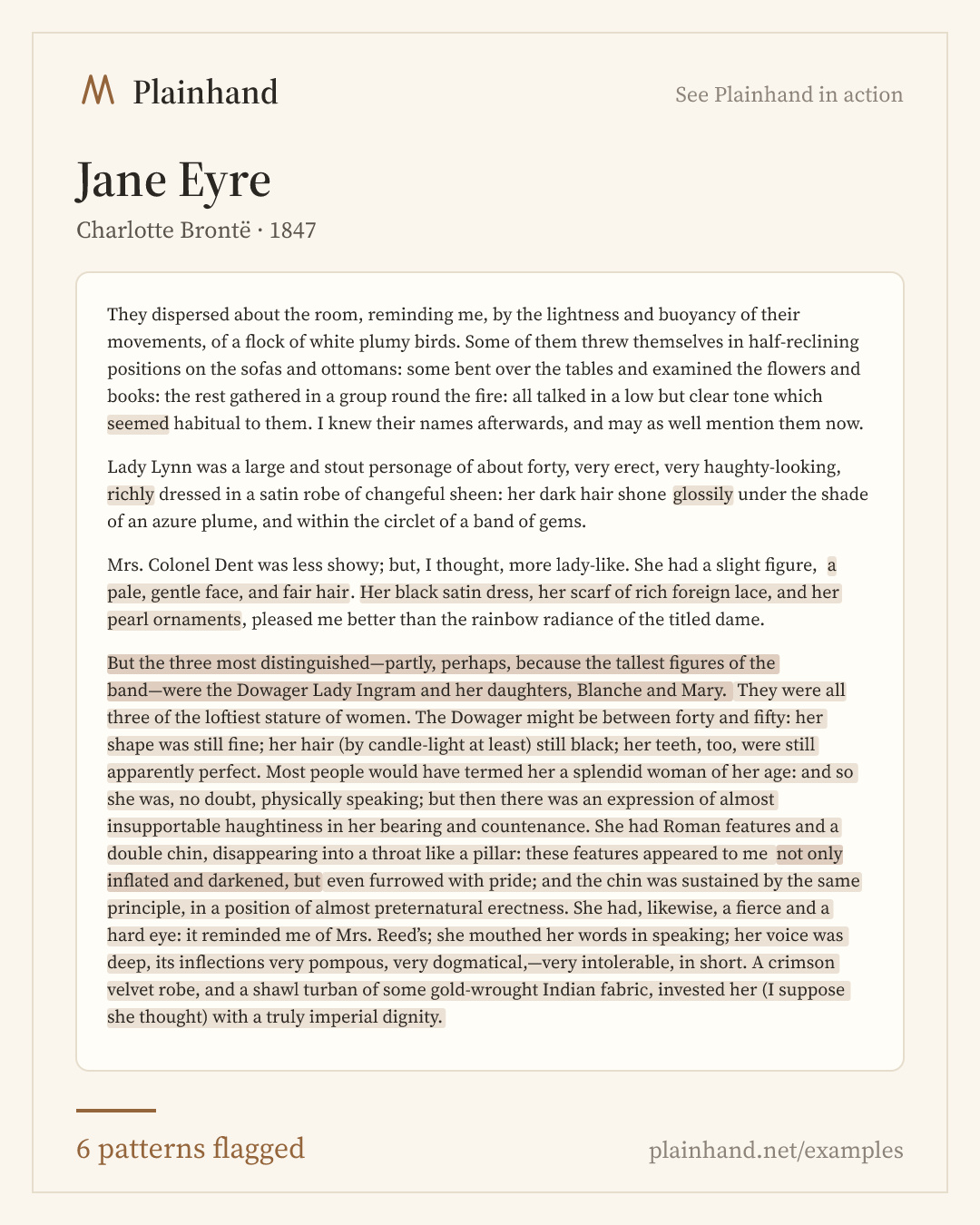
They dispersed about the room, reminding me, by the lightness and buoyancy of their movements, of a flock of white plumy birds. Some of them threw themselves in half-reclining positions on the sofas and ottomans: some bent over the tables and examined the flowers and books: the rest gathered in a group round the fire: all talked in a low but clear tone which 1seemed habitual to them. I knew their names afterwards, and may as well mention them now.
Lady Lynn was a large and stout personage of about forty, very erect, very haughty-looking, 2richly dressed in a satin robe of changeful sheen: her dark hair shone glossily under the shade of an azure plume, and within the circlet of a band of gems.
Mrs. Colonel Dent was less showy; but, I thought, more lady-like. She had a slight figure, 3a pale, gentle face, and fair hair. Her black satin dress, her scarf of rich foreign lace, and her pearl ornaments, pleased me better than the rainbow radiance of the titled dame.
4,5But the three most distinguished—partly, perhaps, because the tallest figures of the band—were the Dowager Lady Ingram and her daughters, Blanche and Mary. They were all three of the loftiest stature of women. The Dowager might be between forty and fifty: her shape was still fine; her hair (by candle-light at least) still black; her teeth, too, were still apparently perfect. Most people would have termed her a splendid woman of her age: and so she was, no doubt, physically speaking; but then there was an expression of almost insupportable haughtiness in her bearing and countenance. She had Roman features and a double chin, disappearing into a throat like a pillar: these features appeared to me 6not only inflated and darkened, but even furrowed with pride; and the chin was sustained by the same principle, in a position of almost preternatural erectness. She had, likewise, a fierce and a hard eye: it reminded me of Mrs. Reed’s; she mouthed her words in speaking; her voice was deep, its inflections very pompous, very dogmatical,—very intolerable, in short. A crimson velvet robe, and a shawl turban of some gold-wrought Indian fabric, invested her (I suppose she thought) with a truly imperial dignity.
Plainhand flagged 6 patterns in this passage.
Jane’s portraits of the guests pile description on description: lists, balanced clauses, and dashes. It’s deliberate, and wonderfully cutting, but it shows how many patterns a long descriptive passage can carry at once.
- Filter words. “seemed” “seemed” hedges what could be shown directly.
- Too many adverbs. “richly” Adverb-heavy in 1 paragraph — most frequent: richly, glossily.
- Three-part lists. “a pale, gentle face, and fair hair” Three-part lists in 1 paragraph — the rhythm can read like a formula.
- Clause symmetry. “But the three most distinguished—partly, perhaps, because the tallest figures of the band—…” Several sentences here split into two halves of nearly equal length — the rhythm can feel mechanical.
- Em-dashes. “But the three most distinguished—partly, perhaps, because the tallest figures of the band—…” This paragraph leans on em-dashes — they lose their punch when overused.
- “Not X, but Y”. “not only inflated and darkened, but” This “not this, but that” pattern can read as formulaic.
Image of this example for sharing
Check your own writing. Paste in a draft and Plainhand highlights these patterns and more, with a short note on each. It never rewrites your words.
Check your writing